Friday, March 14, 2014

Danny MacAskill - Epecuén - 2014 // Street Trials MTB in a Ghost town // Argentina's Villa Epecuén the lost Tourist Village //

[Author notes] Watch as Danny MacAskill brings a forgotten city back to life with his latest street trials film. Following on from 2013's mind-blowing 'MacAskill's Imaginate'
Epecuén is the latest film from Danny MacAskill. 
Directed by long time collaborator Dave Sowerby, we'll see Danny take his riding back to the roots of trials riding, exploring the forgotten town of Epecuén in Argentina, a location that has been submerged for the majority of the past 25 years.

Pablo Novac, Epecuén's only resident throughout the troubled times, gives a brief history of the location culminating with his thoughts that he '...can no longer see what use this place has for us now,' MacAskill however has other ideas.

Be part of the conversation by using #epecuen
_

Experience the world of Red Bull like you have never seen it before. With the best action sports clips on the web and YouTube exclusive series, prepare for your "stoke factor" to be at an all time high.[End]
[Wiki notes] Villa Epecuén was a tourist village that was located in the Buenos Aires Province, Argentina. Now abandoned, its ruins are found on the eastern shore of the Laguna Epecuén, about 7 kilometres (4.3 mi) north of the city of Carhué.

Developed in the early 1920s, Epecuén was accessible from Buenos Aires by train. The Ferrocarril Sarmiento line served the Villa Epecuén station, while the Midland Railway and the Southern Railway carried passengers to nearby Carhué station.[2]

Tourism was well developed in Epecuén, as vacationers from Buenos Aires would seek the therapeutic salty waters of Lago Epecuén. At its height, Villa Epecuén had the capacity to accommodate 5,000 visitors,[3] while unofficial accommodations allowed for 2000 more.[citation needed]

On 10 November 1985, a seiche caused by a rare weather pattern broke a nearby dam first, then the dike protecting the town. Rapidly made uninhabitable, the town saw the waters rise progressively, reaching up to 10 metres (33 ft) at its maximum. The village was never rebuilt.

At the time of the catastrophe, there were up to 280 businesses in Epecuén, including lodges, guesthouses, hotels, and businesses that 25,000 tourists visited between November and March, from the 1950s to the 1970s.

The town reached a population of 1,500 inhabitants at its peak. The town now has a sole resident, Pablo Novak, who returned to his home when the waters receded after covering the town for 25 years.[1]

Pablo's Villa, a 2013 documentary, chronicles the life of the town and of Pablo Novak.[4][5]

The town was used as the setting for an advertisement featuring the street trials cyclist Danny MacAskill released by Red Bull Media House on 27 May 2014.[6] [End Wiki notes]

Monday, February 17, 2014

Off-grid, handcrafted life on Oregon farm & workshop // Sustainable living // Adventure Living // Designing a low-consumption home with sustainable energy and materials //

When you think of the concept of Permaculture, there are various elements interconnected. The home or shelter; the environment surrounding; the soil and water; and the way one connects with their surroundings. This video shows home designs using solar powered energy, and how homes can be built using recycled and natural materials.


[Sustainable living off the grid in Oregon, United States, Authors notes]

The farm is completely off the grid and Schulz points out that this doesn't mean they rely on propane or lots of photovoltaics. Nearly all their tools for living have been adapted to fit the off-grid lifestyle. For his prototype solar-powered bathhouse Schulz used recycled solar hot water panels, salvaged hot water tanks (from the dump), a solar thermal window and a recycled soaking tub. Indoors, Schulz has adapted a chest freezer to create a low-consuming refrigerator (using a tenth of the electricity of a regular fridge) and a 1940s wood-fired stove to cook, heat and as a heat-exchanger, harvesting waste heat and thermo-syphoning water to heat up the home's hot water.

They do have a limited number of photovoltaic panels which produce about 1000 watts of electricity when the sun is shining (for the entire farm), as well as a micro hydro generator in the creek and solar thermal panels.

Schulz models much of what he builds on the Japanese aesthetic and tries to make everything in his life not just functional, but beautiful (e.g. his bathhouse was designed not just as a shower, but as a way to de-stress). 

Schulz is an avid kayaker and for his day job, he builds skin-on-frame kayaks (as well as teach others to build their own).

Cape Falcon Kayak: http://capefalconkayak.com/

Thursday, February 6, 2014

Seoraksan Trekking in South Korea // Winter alternative to the blues // Photo story // Yongpyong Ski // Daecheongbong Ascent 2014 // Inspiration // Microadventure


It's winter around the northern hemisphere when I wish I was traveling by bike in the southern half enjoying their summer down under. What do I do to take up the time (laid-off from teaching over the winter). Winter is a tough season to feel inspired, to be active, and to overcome the monotony of a cold season. Here's what I did to change all that with a few micro adventures, close to home, in Gangwon-do, Korea.

First, I went skiing at Yongpyeong Resort near Hoenggye, South Korea. The all-season resort offers hiking trails in the summer, a water park for families and ski courses for all ages. Although I am not a ski bum, I found some skis that were being thrown out in my apartment complex, Rossignal Viper S 190cm with Marker bindings alpine design - like new condition - for free with Kastle poles. With Nordica race boots, I had enough equipment for the slopes without spending more than $30 on the ski binding settings and the season pass at $400. Ready, steady, go.
My other interest has been winter trekking and staying overnight inside Seoraksan National Park. Hiking and mountain trekking is probably the best winter past-time activity in Gangwon-do, Korea. My friend Zac is trail running as well, so there are several ways to enjoy the trails. We don't have groomed trails like in the United States, so Fatbikes aren't an option just yet. However, the Winter Olympics 2018 are coming and perhaps more winter sports will take off when it comes bringing more Western culture sports to Korea.
 Another wintry day up at 1500 meters above sea level. Location of the 2018 Winter Olympics.
 The Green is an intermediate slope and they are building the snowboard course on the left side.
 I am not a winter person, hate the long nights and short days of winter. Staying frosty here though and passing the time before going back for the final year of teaching in Korea.
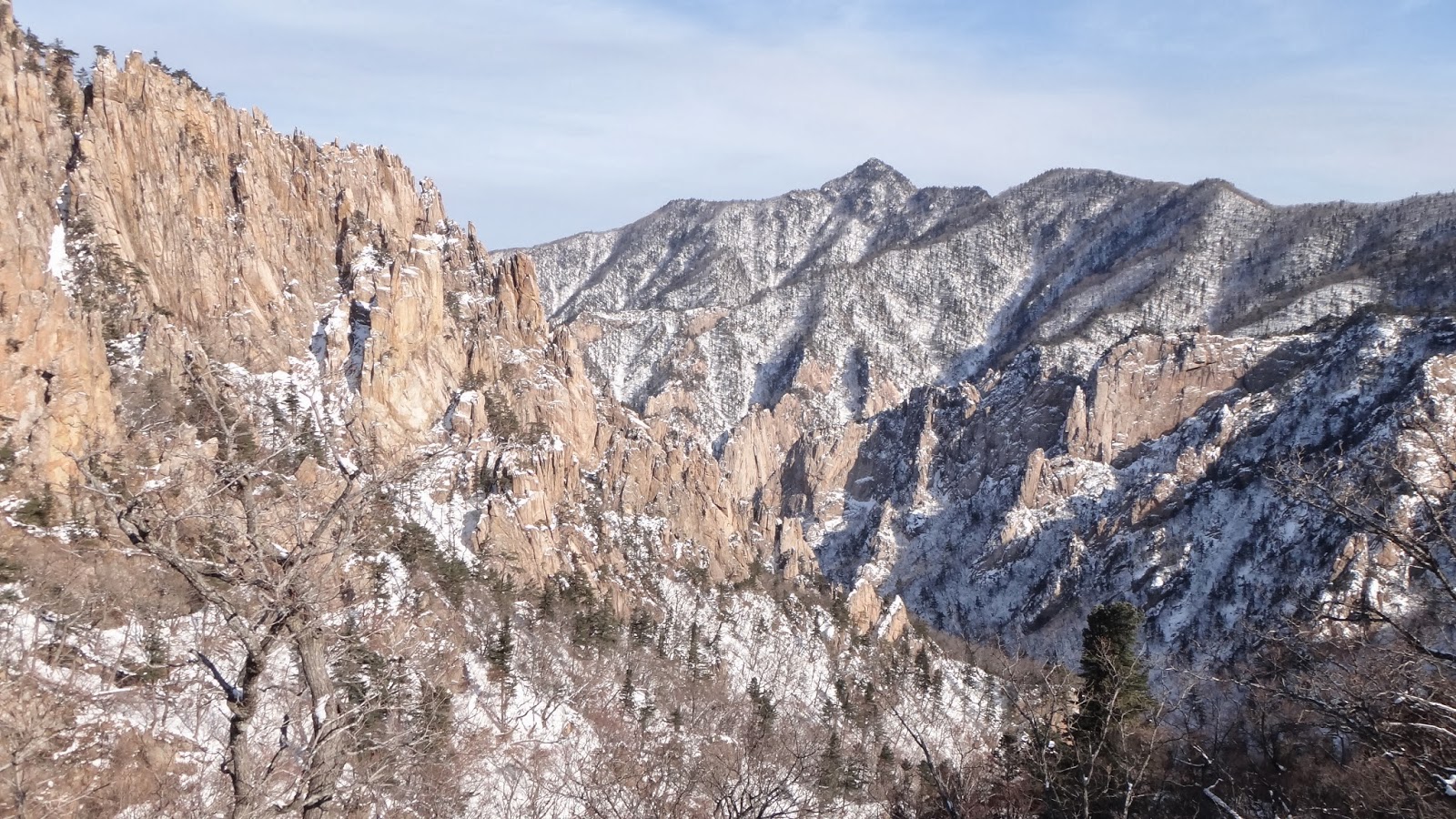
 This is the view on the walk into Seoraksan National Park. I usually start at the park administration building and walk 2 kilometers to the official entrance near the Buddhist temples. What starts out as a casual hike into the park entrance past the bronze Buddha at Sinheungsa temple becomes a vigorous trek to the peak.
 The flat first 2 km are perfect for in/out of the park. This is a 12-18 hour trek to Daecheongbong Peak located 12 kilometers inside the park at 1708 meters above sea level.
 Ancient stones recreated and assembled as long ago.
 The views are spectacular. Everyone who visits South Korea in the winter should visit this area.
 I met this super friendly professional photographer. His photos were mind-blowing and he completes projects on nature, the environment, and female nudes. All amazing work, thanked him for sharing.
 The trail is designed with staircases, bridges, and hard rock paths. Most hikers will wear their ice crampons, which are attached with rubber belts or chain mesh designs, the price ranges from $5-25 for a set.
 The sunlight strikes inside these valleys for stunning winter scenery


 This is the view about half way into the climb.


 I met a college student group, they were awesome in sharing their trek to the Daecheongbong Peak 1708m and we spent the night at the Socheong shelter while EBS (Educational Broadcasting Station) was filming for the their February broadcast of Extreme Jobs. The episode covered Mountain Rescue EMS teams.

 This is one of the two peaks, with military satellite reception on top. Winds were really blowing up there.
 Here's our group, sorry I don't have all your names written here. This is inside the Socheong shelter (7,000won per night, reservations recommended)
 Outside it was cold, the winds picked up to 28 meters/second.


 This is the Socheong shelter just 600 meters away from Daecheongbong Peak.


 We made it all the way to the top as a team. An awesome day for sure.

 EBS filming on location. Their battery packs were losing charge, it was very cold that morning.


 Sweet sunrise at the peak!


 Epic trails and views from the top. This trek is from the main park entrance at Sokcho-dong.


And I hiked out of the park with this woman, she bought me herbal tea at a mountain shop when we parted ways. It's quite common to meet people on South Korean mountains, share some short conversation (in many cases English is not fluently understood or spoken) and share some tea or dinner at the shelter. Reservations must be made in advance for weekends, even in winter.

If you are interested in more information about Seoraksan National Park, read my earlier blog from 2012/13

Thanks for visiting the Korean-World. - Brian.

---
Adventure, Be positive, Stay Healthy.

and remember to live the life we have been given. 
Life today in the present.

Find Inspiration Outside with Nature.

Strive to be Happy.